
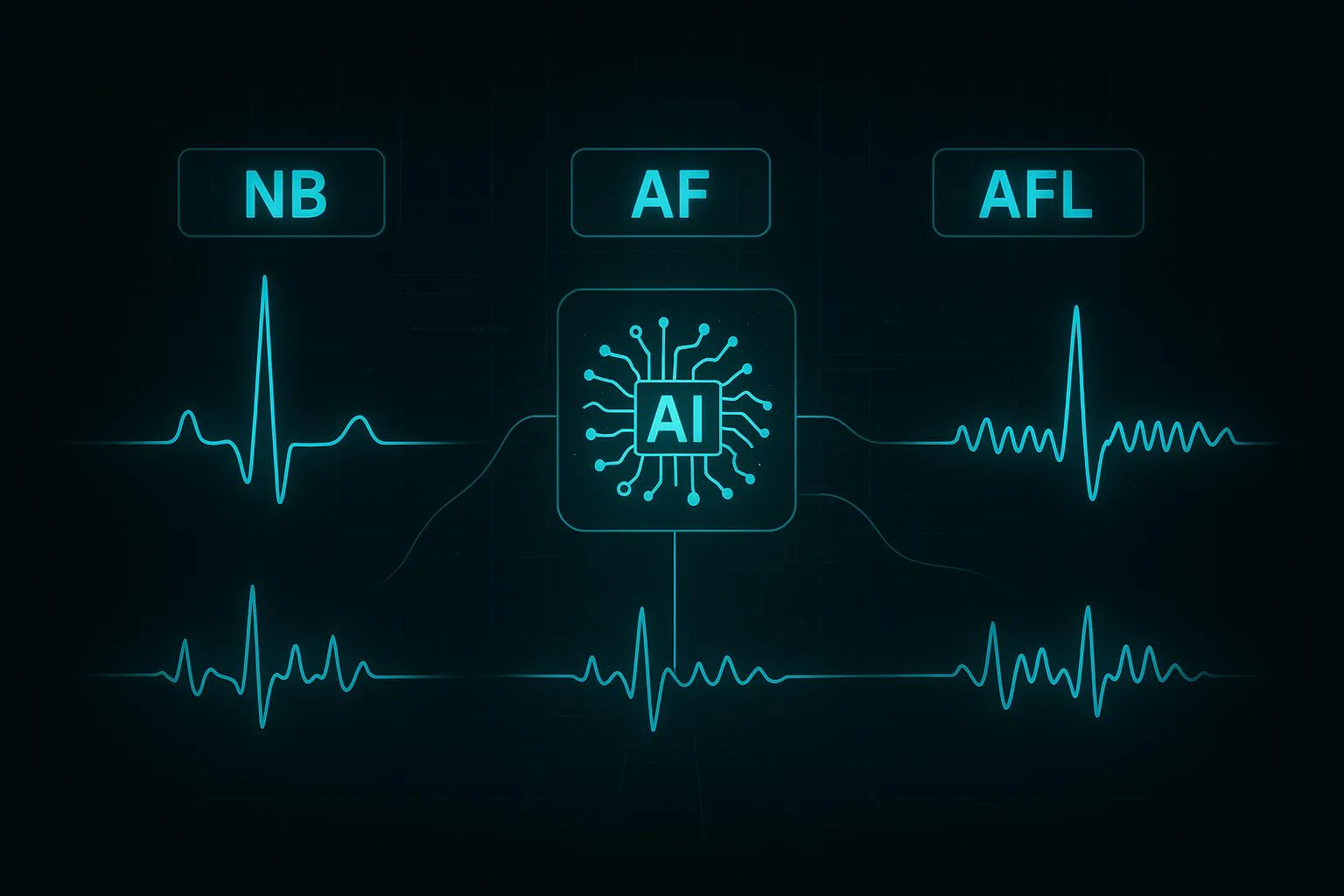
Electrocardiogram (ECG) interpretation remains a critical but challenging task in cardiology. Differentiating normal (N) rhythms from atrial fibrillation (AF) or distinguishing AF from atrial flutter (AFL) can be difficult due to subtle waveform similarities.
Globally, AI companies and research teams are investing tremendous effort to develop precise beat classification algorithms that improve diagnostic accuracy and reduce variability among clinicians. The MEDTL team is proud to report that our AI models consistently achieve excellent performance in worldwide comparisons.
By leveraging deep learning on extensive annotated datasets, our system reliably classifies ECG signals into normal (N), supraventricular (S), AF, and AFL rhythms, supporting early detection and optimized treatment strategies.
Our approach combines advanced signal preprocessing, feature extraction, and neural network classification to ensure accurate rhythm detection even in challenging cases:
Preprocessing removes noise and baseline drift, enhancing signal quality.
Feature extraction captures subtle temporal and morphological patterns characteristic of each rhythm type.
A convolutional neural network (CNN) then classifies beats into N, S, AF, or AFL with high accuracy, even when differences are subtle.
Adopting AI-based ECG classification provides several benefits for clinicians:
Enhances early detection of arrhythmias in outpatient and emergency settings.
Reduces inter-observer variability, increasing diagnostic confidence.
Supports personalized treatment plans by distinguishing AF from AFL, guiding anticoagulation and ablation strategies.
Demonstrates exceptional performance in global benchmarks, confirming the robustness and reliability of MEDTL AI algorithms.